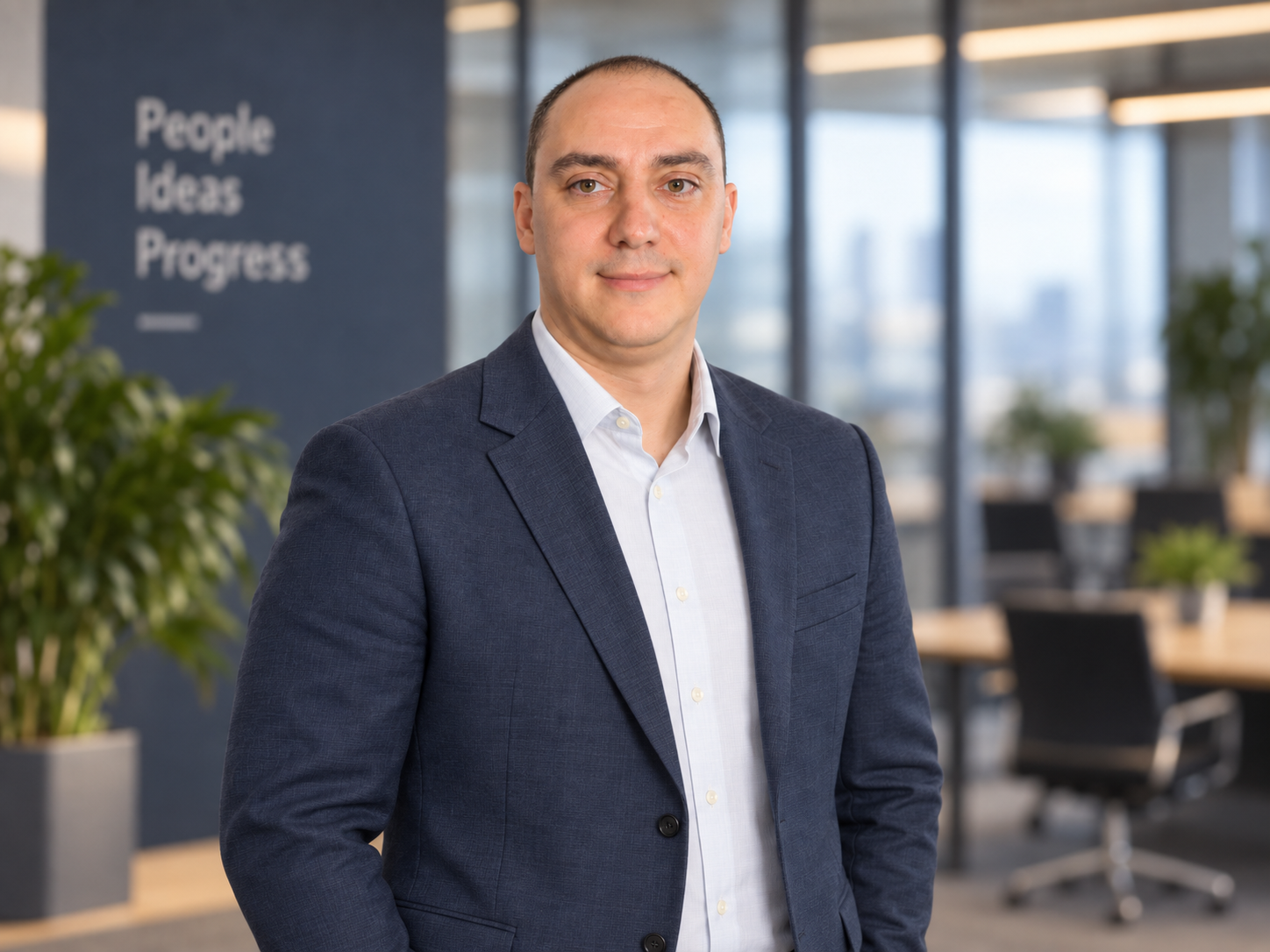
Alex Pescar is a programmer and entrepreneur originally from Romania who has been living in the south of the Republic of Moldova for more than a decade. Here, he started a family and continued his professional career, turning his programming experience into solutions for the concrete needs of local businesses.
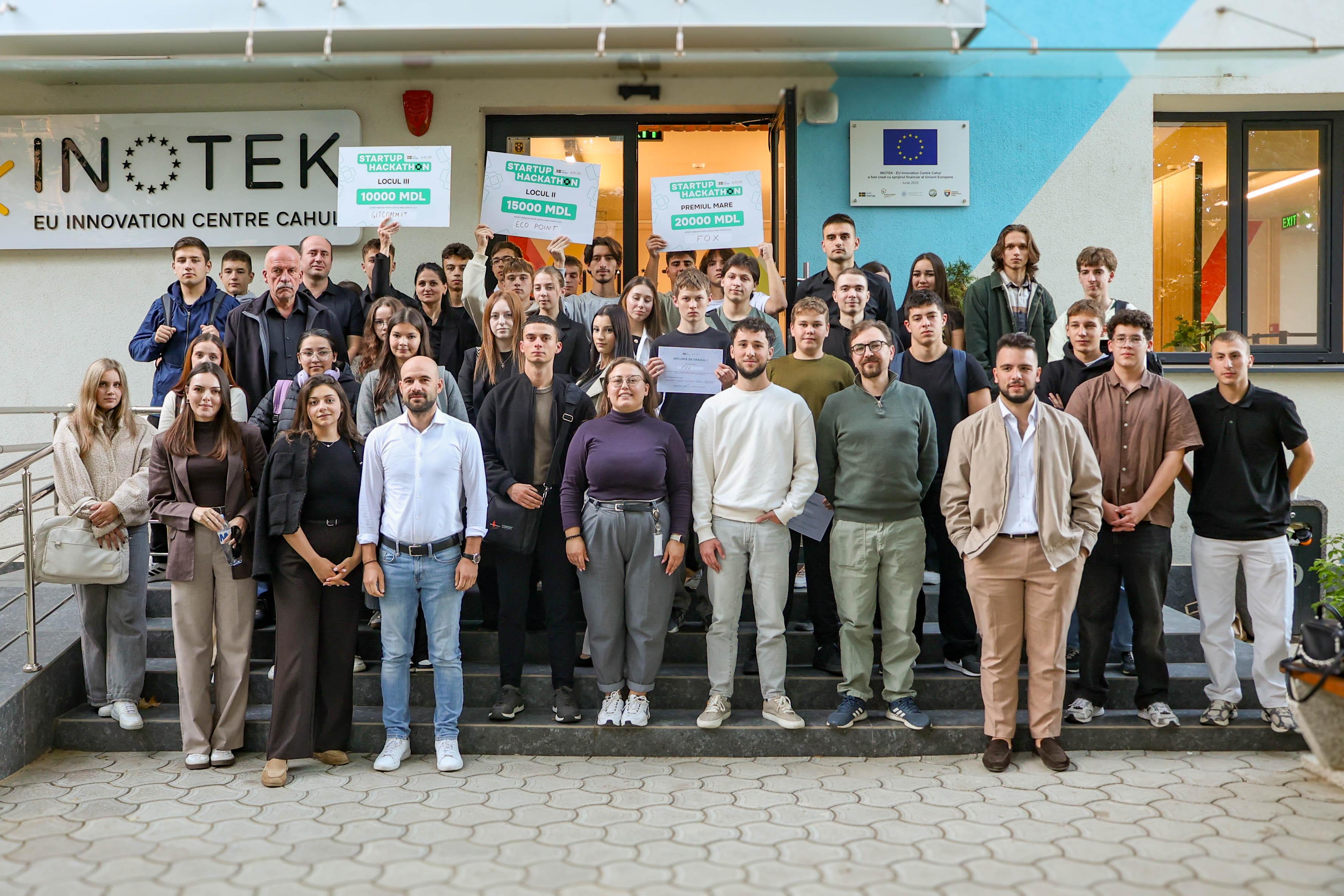
He is the creator of SmartCafé, a program born from a problem he encountered in his own business and now used by more than 100 clients across the country. We are delighted to have him with us as a participant in Business Breakfast, Cahul Business Summit, training sessions, and other initiatives organized by Inotek Center.
In the story below, Alex speaks in his own words about his professional journey, the beginnings of SmartCafé, and his connection to Moldova.
”It all started with a green-screen computer
My story in IT began sometime around 1995, almost out of curiosity. I was a child when I enrolled at the Children’s Club in Hunedoara, Romania. It was a place where you could discover all kinds of things, organized into several sections, one of which was programming.
At the time, I had no idea that this choice, made mostly out of curiosity, would shape my entire professional life. The programming lab was something that today would seem almost like another world. There were around 25 computers. I say “computers” because, seen through today’s eyes, they were very different from what we imagine when we hear that word. They were basically keyboards connected to black-and-white monitors, and, as far as I remember, the image had a somewhat greenish tint.
The monitors ran for hours and gave off a heat that I still remember today. But more than the heat, I remember the smell of hot dust, which, after so many years, somehow stays imprinted in your mind. If I walked into a room today and smelled exactly that scent, I would probably be transported back to that lab in Hunedoara for a few seconds. It was in that lab, at the city’s Children’s Club, that I began programming in QBasic.
I had no internet. I had no YouTube tutorials. Google did not exist and, of course, neither did ChatGPT. I had the computer, a manual, and the curiosity to see what would happen if I changed a line of code. And perhaps that was precisely the beautiful part. I could not look up the answer immediately. I had to try, make mistakes, make changes, and try again.
About two years after joining that club, I experienced a moment that was extraordinary for me. The lab received a Pentium I PC. To someone used to the computers in the lab, that machine seemed almost unbelievable. It had a system unit, a separate keyboard, and a color monitor. A color monitor. Today, that may seem like a trivial detail, but back then it was a real pleasure to sit in front of it and simply watch it “work.” The computer ran Windows 95, and I began working with Pascal.
Pascal was one of the languages that shaped entire generations of programmers. For me, it was the period when I began to understand that a computer was not just a machine that ran programs made by other people. I could tell it what to do. And I found that fascinating.
During that same period, I also had the chance to receive another computer from the United States. Having access to those computers meant a great deal to me. I was able to experiment, learn on my own, and gradually develop my programming skills.
Years followed in which programming became increasingly important to me. I took part in computer science olympiads and competitions, both in programming and applied computer science. It was not only about writing code. It was about finding solutions, using logic, looking at a problem from a different angle, and not giving up when the first solution did not work.
Later, while I was at university, programming became part of a much more unusual project. For my master’s thesis, I used what I had learned to develop software that calculated a Mars landing. Yes, on Mars. It may sound unusual, but the project had a very concrete purpose: to perform simulations needed in the field of physics. What still makes me happy today is that the software did not remain merely a master’s thesis forgotten in an archive. It is still used by the Faculty of Physics at the West University of Timișoara for Mars landing simulations.
For me, this was one of those moments when I realized that programming could be much more than a job. You can build something that other people can use. You can take a problem from a field you may not know very much about and create a tool to solve it.


What I have learned over the years
Over time, I came to understand that a good program does not necessarily start with code. It starts with a problem. You have to understand what troubles the person in front of you, what makes them lose time, money, or energy, and only then consider whether technology can solve that problem. This is probably one of the reasons why all the projects we have worked on reflect who we are. Each one has meant something. Each one has taught us something. Each one has forced us to become better.
Today, we have AI. A large part of the code can be generated with the help of artificial intelligence. Sometimes AI can even write most of the code for a feature, but that does not mean the programmer has become unnecessary. Quite the opposite! The more powerful the tools become, the more important it is to understand what you are building.
AI-generated code must be understood, reviewed, tested, and adapted. You need to know whether the solution is correct, whether it is secure, whether it can be maintained, and whether it truly solves the problem it was created for. AI is changing the programmer’s profession. It is not eliminating it!
Moldova
I arrived in the Republic of Moldova around 2012. After all the years in which programming had been part of my life, I began to look at things here from a different perspective.
I realized fairly quickly that the experience I had accumulated could be useful in a market where many things still needed to be built and modernized. I noticed that many businesses needed software but either did not have such solutions or were using programs that were not adapted to their reality. To me, this was not necessarily a disadvantage. Quite the opposite. I saw an opportunity. I told myself that developing software for different sectors in the Republic of Moldova was not only possible, but also necessary. But the real change would come a few years later and, in a way, from my own business.
In 2016, I opened a pizzeria in the city of Taraclia. At first, I was naturally focused on the restaurant side of things. Finding suppliers, organizing everything, serving customers, and making the business work. But it did not take long for me to understand that a business like this could not be managed efficiently without a program to handle a large part of that work.
The reality was quite simple. Customer accounts were kept on paper. They could be rewritten at any time. The cash takings could quickly become a mess. Using the cash register was a nightmare. All those PLU codes had to be memorized, or you had to keep lists of them beside the register. And real-time inventory? It was almost a beautiful dream. But I knew how to program. And I began to wonder: if there was no program to solve my problems, why not build it myself?
That is how the first version of SmartCafé appeared. It did not begin in an office, with a marketing team, a complicated business plan, and a strategy for the next five years. It began in a pizzeria. I built the program for myself. I needed to see what was happening with sales, products, inventory, orders, and money. I needed things to be simpler and easier to control. And as I worked on it, I began to notice something. My problem was not only my problem. A great many restaurants, cafés, and bars faced exactly the same difficulties. That was when I realized that the software I had built for my own business could become a product.
The first clients were not long in coming. The city of Cahul played an important role in our story. Because it is relatively close to Taraclia, it was there that we found our first clients who trusted what we were doing. For us, Cahul was a real launchpad. From there, things began to grow. One client came with a problem. Solving that problem revealed another need. Then another client arrived with a different situation. And, without realizing it, SmartCafé began to be built not only from what we thought such a program should include, but also from the real problems of the people who used it. I believe this is one of the reasons the product has evolved so much. We treat every client individually. Every business has its own particularities. Every owner works a little differently. Every field has its own problems. Every project teaches us something. It makes us better, forces us to find new solutions, and helps us grow as well.
Today, about ten years after the beginning of this journey, SmartCafé has more than 100 clients nationwide. When I look back, I find the connection between all these stages interesting.
I started in 1995 in a lab in Hunedoara, with QBasic and computers whose monitors heated the room. I went through Pascal, Windows 3.1, Windows 3.11, Windows 95, computer science competitions, and olympiads. I went on to develop a program that simulated landing on Mars, a program that is still used today by the Faculty of Physics at the West University of Timișoara.
I arrived in the Republic of Moldova and then opened a pizzeria. And that pizzeria brought me back to what I had been doing since childhood: programming.
Only this time, I was no longer programming for a competition or a university project. I was programming for real problems.
What I would tell a young person
If I could go back for a few minutes to the child I was in 1995 and tell him what lay ahead, he probably would not believe me.
I do not think anyone could have told me then that the programming I was learning in a lab with black-and-white monitors would become my profession and that, more than 30 years later, I would be sitting in front of incomparably more powerful systems and building software used by businesses in the Republic of Moldova.
That is why, if a young person asked me today whether it is worth choosing IT, I would tell them not to think first about the salary, modern offices, or what they see online. They should think about whether they enjoy discovering how things work. Whether they enjoy looking for solutions. Whether they can spend hours facing a problem and refuse to give up until they find an answer. Because that, ultimately, is what programming is. It is not only about code. It is about thinking, patience, creativity, and the desire to build something.
And there is something else I would like to tell them:
Do not wait until you have the perfect conditions to begin!
I started with a computer that would probably look like a relic today. I did not have the internet we have now, I did not have video tutorials, and I did not have artificial intelligence that could explain a problem to me in a few seconds.
But we had curiosity, and sometimes that is enough for the first step.
I do not know where IT will be in another 30 years. We probably cannot even imagine it accurately. But I know one thing: there will always be problems that need to be solved and people who will have to invent the solutions.
Perhaps one of those people is a young person who does not yet know that they enjoy programming. Perhaps they simply have not yet had their first green-screen computer. I did not begin in 1995 with a career plan. I began because I was curious and wanted to see what a computer could do; that curiosity took me from QBasic to Pascal, from a Pentium I PC to simulations for the planet Mars, and later to software for businesses in the Republic of Moldova.
If there is one thing I would change, it probably would not be my decision to enter IT. Quite the opposite! Looking back, I believe that signing up, almost out of curiosity, at a children’s club in Hunedoara was one of the most important choices I have made in my life. And perhaps this is the simplest conclusion I can share with a young person:
You don’t need to know where you’ll end up, you just need to start and then stay curious.”