Overview
How can a sensor turn on a light automatically? How does an alarm, access control system or smart home work?
During the course, children discover the answers by building and programming their own electronic devices. They learn to connect circuits, control LEDs, sensors, displays and motors, and write code in C++ using the Arduino IDE.
The course starts with the basics and gradually progresses to complex projects. No previous experience in electronics or programming is required.
WHAT IS ARDUINO?
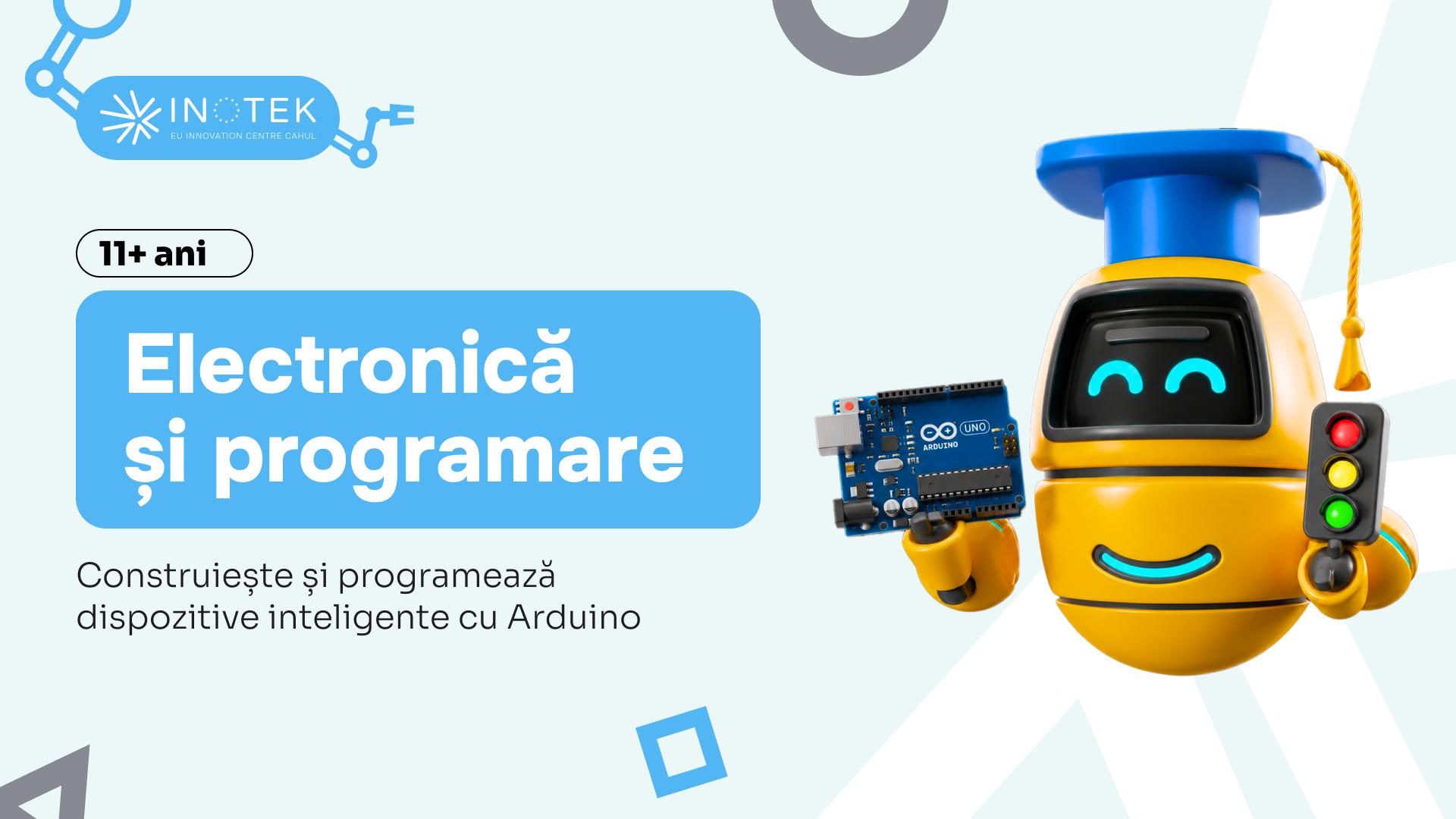
Arduino is a programmable electronics platform that can be used to create various smart devices. Children connect components such as sensors, lights, buttons, displays and motors, then write the code that makes them work.
This means programming does not remain only on the screen: every line of code produces a result that the child can see, test and improve.
WHO IS THE COURSE FOR?
The course is suitable for children aged 11 and older who:
- are curious to learn how technology works;
- want to learn programming through hands-on activities;
- are interested in robotics, electronics and inventions;
- want to build real projects, not just listen to explanations;
- have never worked with Arduino and want to start from scratch.
WHAT WILL YOUR CHILD LEARN?
During the course, your child will learn to:
- build electronic circuits on a breadboard;
- program in C++ using the Arduino IDE;
- control LEDs, buttons, displays and sound signals;
- collect data using light, temperature, humidity, rain, vibration and sound sensors;
- control motors and other electronic components;
- create password-protected systems and RFID access systems;
- organise code and identify errors;
- combine several components into a single functional device;
- test, improve and present their own projects.
HOW IS THE COURSE ORGANISED?
The course takes a hands-on approach. In each lesson, children discover a new concept, connect the components and write the code needed to control them.
They work individually and in pairs, solve challenges and learn to find solutions when a circuit or program does not work on the first attempt. Mistakes become a natural part of the learning process and help them develop patience and logical thinking.
The programme includes:
- 35 lessons
- 2 hours per lesson
- 70 hours of hands-on activities
- 7 progressive modules
- 4 final projects
WHAT DOES THE CURRICULUM INCLUDE?
MODULE 1: FUNDAMENTALS OF ELECTRONICS AND PROGRAMMING
Children are introduced to the Arduino board, learn how an electrical circuit works and write their first programs. They will control LEDs and buttons and, among other things, build a working traffic light.
MODULE 2: SENSORS, SOUNDS AND DISPLAYS
Participants work with light sensors, sound signals, digital displays and LED matrices. They create counters, timers, animations and mini-games.
MODULE 3: ADVANCED COMPONENTS AND COMMUNICATION
Children learn to display text and data on an LCD screen, measure temperature and humidity, and control devices using a remote control.
MODULE 4: DETECTION AND ALERT SYSTEMS
Participants use vibration, rain, flame and sound sensors. Based on the data collected, they program light and sound alerts and create simple monitoring systems.
MODULE 5: ACCESS, REAL-TIME SYSTEMS AND MOTORS
Children build a digital clock, a password-protected system and an RFID card access system. They also learn to control motors and automate various mechanisms.
MODULE 6: ADVANCED C++ PROGRAMMING
Participants develop their programming knowledge and learn to organise their code more effectively, work with functions, data lists and non-volatile memory, and control the Arduino board from a computer.
MODULE 7: FINAL PROJECTS AND DEMO DAY
In the final part of the course, children combine the knowledge they have gained and build complex projects. At the end, they present their solutions during a Demo Day.
FINAL PROJECTS
Participants will work on four projects:
- Weather station – measures temperature, humidity and light and generates automatic alerts;
- Security system – verifies access using an RFID card and PIN code;
- Smart home – combines several sensors and automates various functions;
- Mini game console – includes a joystick, display, score, sounds and lighting effects.
WHAT SKILLS WILL YOUR CHILD DEVELOP?
In addition to programming and electronics knowledge, the course helps develop:
- logical and algorithmic thinking;
- problem-solving skills;
- creativity and initiative;
- patience and attention to detail;
- teamwork;
- the ability to explain and present a project.
WHY IS THIS KNOWLEDGE USEFUL?
Electronics and programming form the foundation of many technologies around us: robots, automated systems, smart devices, IoT solutions and smart city technologies.
With Arduino, children do not simply use technology; they begin to understand how it is built and how they can turn it into a solution of their own. The course gives them a practical foundation in fields such as robotics, automation, programming, electronics and engineering.
At the end of the programme, participants present their projects and receive a certificate of completion.
Price and Discounts
Course fee: 700 MDL/month
You can receive a 5% discount if:
- you enroll two or more children from the same family in Inotek courses;
- your child attends two Inotek courses at the same time;
- you pay the full semester fee in a single payment.
You can save up to 10% if you pay for the full semester in advance and qualify for one additional discount.
Contact number: 060502641

 Level
Level  Term
Term  Days
Days  Program
  Present
  Location
  Language of instruction