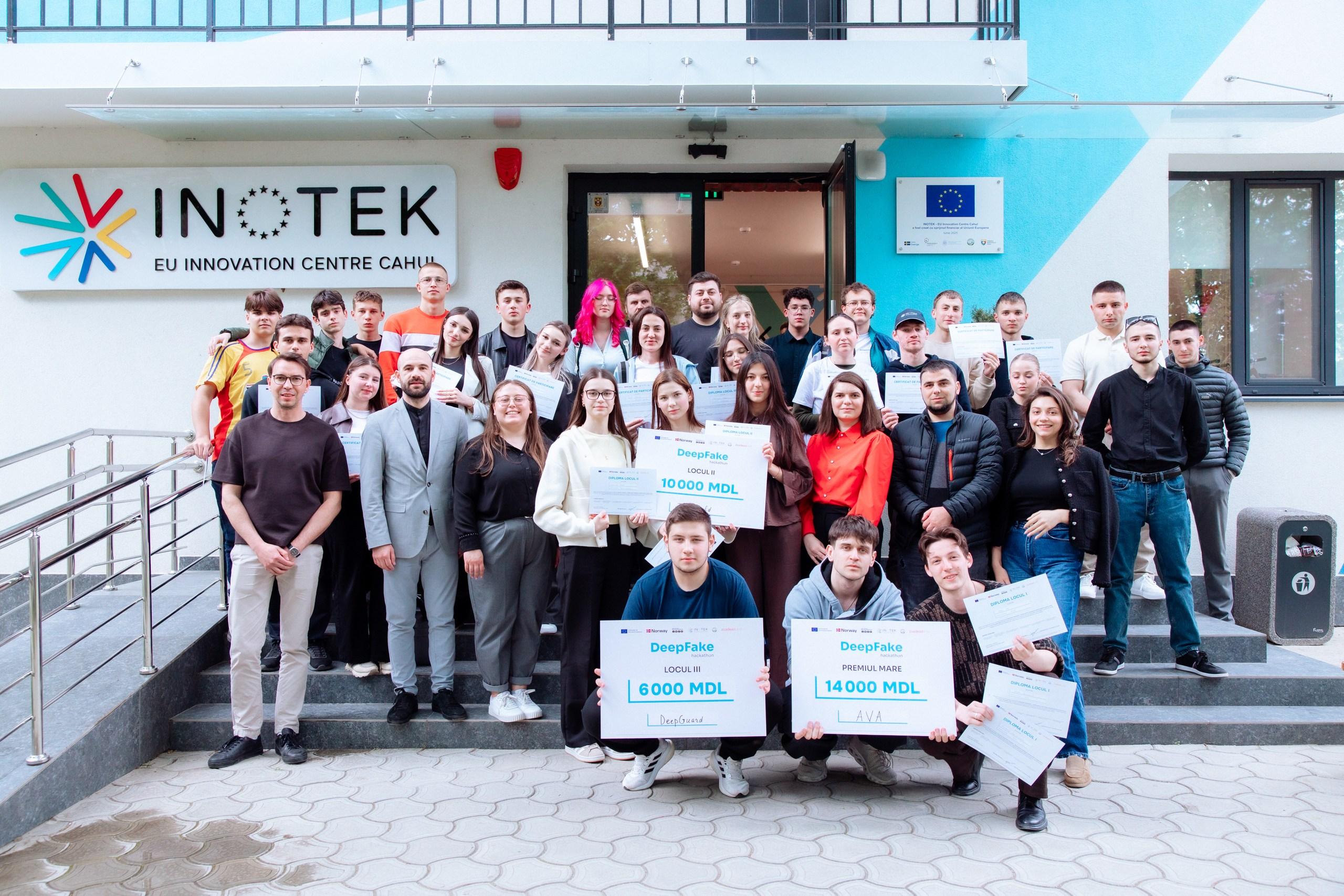
Against the backdrop of rapidly advancing digital manipulation technologies, 56 young people from the southern region of the country gathered at Inotek Center to identify practical solutions to the DeepFake phenomenon. Over the course of three intensive working days, participants developed 15 prototypes aimed at protecting the information space and raising public awareness of online disinformation risks.
The event highlighted the need for a critical approach to digital content, equipping young people with the tools to turn ideas into functional products. Projects were evaluated by the jury based on the clarity of the identified problem, the viability of the technical solution, and the potential for social impact.
“For IWPR, as an organization involved in implementing projects in the field of information resilience, it is important to support initiatives that provide concrete solutions to real societal challenges. The hackathon in Cahul demonstrates that both interest and innovation capacity exist within local communities. Through such initiatives, we contribute to building a more resilient, critical, and well-prepared generation capable of defending the information space of the Republic of Moldova,” said Lilian Hîncu, representative of the Institute for War & Peace Reporting (IWPR).
The competition featured a wide range of solutions, from educational platforms for older adults to complex real-time video manipulation detection systems. Teams were guided by mentors with expertise in journalism, IT, and artificial intelligence, who supported them in refining their information verification mechanisms.
“Organizing the DeepFake Hackathon represents a strategic initiative to strengthen digital skills and societal resilience in the face of disinformation. By engaging young people from diverse fields and fostering interdisciplinary collaboration, the event contributed to the development of innovative solutions designed to identify and counter manipulative online content,” stated Nicolae Mocanu, Administrator of Inotek Center.
Among the most notable projects were browser extensions that flag sources of disinformation, educational Telegram chatbots, and AI-based semantic analysis models. These tools are designed to support both everyday users and media professionals in the fact-checking process.
“At the end of April, I returned to Cahul for the Deepfake Media Hackathon, where technology, media literacy, and critical thinking came together in a practical setting. My role was to help over 50 young participants transform their ideas into solutions for tackling disinformation and AI-generated manipulative content, guiding them to reach clear MVPs within just three days. The result was 15 ideas, prototypes, and verification mechanisms that can help people and journalists more easily identify false information, manipulated images, and deepfake content. However, the most important outcome remains the process itself: 50 young people who learned to think more critically, define problems more clearly, and approach online disinformation with greater caution. I thank the Inotek team for bringing such opportunities to the southern region and turning important topics into practical learning experiences,” said Aurica Apareci, mentor at the DeepFake Hackathon.
Following deliberations, the winning teams were:
1st place – AVA (14,000 MDL): a platform that analyzes images and video to detect digital manipulation and hidden edits.
2nd place – Truth Shield (10,000 MDL): a browser extension, “Press Shield,” that identifies manipulative comments and coordinated behavior in discussion sections.
3rd place – DeepGuard (6,000 MDL): an AI-based model that detects fake news through semantic analysis and comparison with verified databases.
Participants described the experience as a race against the clock that pushed their creative and technical limits. Beyond the competitive aspect, the event provided hands-on insight into how manipulation algorithms work and how they can be countered through technology.
“The hackathon was an intense time challenge, but with the support of mentors, we managed to turn an ambitious idea into a nearly finished product in just three days. This award gives us the resources to upgrade our technical infrastructure and take our anti-deepfake analysis solution to the next level. Our goal is for this project to become an essential tool for news agencies in the fight for truth in the digital space,” said Ion Tofan, member of the winning team AVA.
Innovative solutions developed during the hackathon include:
- FakeBusters: an interactive educational platform that trains users to identify fake news through simulated scenarios and real-life cases.
- FakeDev: an automated system that verifies information across multiple sources and assigns a credibility score.
- Serozet: a tool for journalists that reduces fact-checking time through automation.
- Control X: a browser extension that analyzes web pages in real time and flags potential sources of disinformation.
- Adevărul Digital: a digital literacy initiative using video content (TikTok), targeting older audiences.
- The Mafia: a web platform that evaluates the level of manipulation in a text and identifies techniques such as clickbait or emotional framing.
- Java-Script: a chatbot that verifies information and provides quick responses in conversations.
- InfoECOU Sud: an educational Telegram chatbot explaining how disinformation works and how to recognize it.
- DMC: a real-time deepfake detection system for video calls.
- 7 lei motorină bă: a simplified mobile app that quickly analyzes online content and indicates its credibility.
- NoTechNoLife: an overlay interface that provides instant credibility checks over viewed content.
- Juris Elite: a comprehensive digital ecosystem integrating tools for detecting, analyzing, and reporting fake news.
The DeepFake Hackathon demonstrated that technological innovation, when applied in the service of truth, can act as a strong shield against digital manipulation, strengthening information resilience in the southern region of the Republic of Moldova.
This event is organized with the financial support of the European Union, co-funded by Norway, and implemented by Inotek Center in partnership with “B.P. Hasdeu” University Center in Cahul and ziuadeazi.md. The content and discussions within the event are the sole responsibility of Inotek Center and do not necessarily reflect the views of the European Union or the Government of Norway.